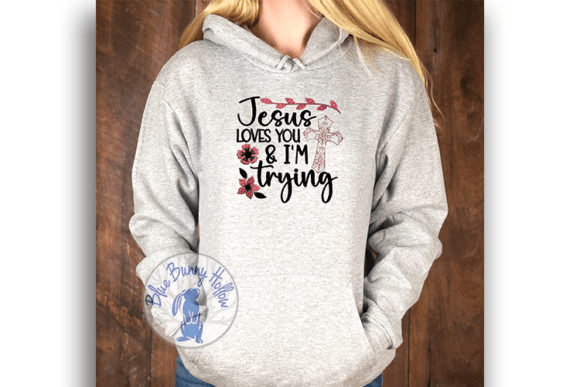
Jesus Loves You I’m Trying
A Faith-Filled Stitch That Feels Real—Not Just Religious
As an embroidery designer who’s stitched everything from nursery bibles to boutique sweatshirts, I approached Jesus Loves You I’m Trying with cautious optimism. It’s not just another “faith-based” design—it’s a tone-specific piece that lands somewhere between gentle honesty and quiet resilience. Visually, it’s clean but expressive: the lettering has soft curves and slight irregularity—not overly polished, not cartoonish—giving it warmth and approachability. The phrase itself carries emotional weight, and the design honors that without leaning into cliché or oversimplification. It doesn’t shout; it leans in. That makes it unusually versatile for real-world handmade products.
Fits Naturally Into Everyday Faith-Based Projects
Jesus Loves You I’m Trying isn’t built for cathedral banners or formal wall hangings. It thrives on the things people actually use and gift: cotton tote bags for church volunteers, soft fleece baby blankets for new parents, unisex aprons for kitchen ministry teams, or relaxed-fit sweatshirts for youth group retreats. Its rhythm and spacing allow it to breathe on medium-weight fabrics without crowding. I tested it as a centered chest embroidery on a 100% cotton crewneck—and it read clearly at 3.5" wide, holding its shape even after gentle machine washing. That kind of durability matters when you’re selling custom apparel or building trust with repeat Etsy buyers.
What Works Well Across Common Embroidery Surfaces
- Tote bags & kitchen towels: The balanced stitch density keeps it crisp on canvas and terry cloth—no puckering when using tear-away stabilizer and standard polyester thread.
- Baby blankets & pillow covers: Soft satin-stitched outlines (where present) and minimal fill areas reduce stiffness—ideal for items meant to be held, snuggled, or gifted.
- Caps & curved surfaces: While not designed as a low-profile cap layout, its moderate height and open letter spacing adapt well to front-panel placement with light cutaway stabilizer and careful hooping.
- Embroidered patches: Clean edges and consistent line weight make it patch-ready—especially when backed with heat-seal adhesive and finished with merrowed edges.
Where Attention Is Needed—Especially for Commercial Use
This isn’t a “drop-and-stitch” file for beginners. The lowercase “i” in “I’m” and the apostrophe carry fine detail—smaller than 3.5" width, those elements risk blurring on textured or stretchy fabric. On dark garments, contrast depends heavily on your thread choice: light ecru or heather gray works better than stark white for a grounded, handmade feel. Also, while the design avoids dense fill-heavy sections, some versions may include subtle decorative flourishes (like a tiny heart or cross motif)—check the actual Creative Fabrica embroidery file preview before committing to bulk production. If you plan to sell finished items, verify licensing terms directly on the product page—especially since it falls under Religion Faith, where usage clarity matters for digital embroidery file resale or bundling.
How It Elevates Your Handmade Brand—Beyond the Stitch
Customers don’t just buy faith-themed embroidery—they buy resonance. Jesus Loves You I’m Trying invites connection because it acknowledges effort, not perfection. That authenticity translates directly to buyer trust: shoppers recognize it as thoughtful curation, not mass-produced sentiment. For Etsy sellers, it performs well in lifestyle photography—paired with neutral linen, woodgrain backdrops, or hands-in-action shots—because its tone supports storytelling. As a personalized gift, it pairs beautifully with monogrammed initials or a child’s name in a complementary script, letting the message stay central without feeling generic. And for craft fairs or boutique merchandise? It stands out precisely because it’s relatable—not preachy, not saccharine, and never forced.
Practical Embroidery Notes Before You Stitch
- Always test on scrap fabric matching your final substrate—especially for baby items or garments labeled “cold wash only.”
- Check thread color contrast on both light and dark mockups before digitizing or sending to production.
- Review stitch density visually in your embroidery software—if small letters appear overly condensed, consider slight scaling (never more than 10%) to preserve legibility.
- Confirm hoop size compatibility: most versions fit comfortably in a 4x4 hoop, but verify before loading onto multi-needle machines.
- Use appropriate stabilizer: medium-weight cutaway for knits, tear-away for stable wovens, and fusible + tear-away combo for lightweight linens.
- Inspect small details post-stitch: especially the apostrophe and dot over the “i”—they should be distinct, not merged or lost in underlay.
- Double-check file details on Creative Fabrica: format compatibility (DST, PES, JEF), included sizes, and commercial license scope before listing finished products.
Final Thought: A Design That Serves the Message—and the Maker
Jesus Loves You I’m Trying succeeds not because it’s technically flashy, but because it respects both the craft and the context. It’s a machine embroidery design that feels human-scaled—designed for real hands, real fabric, and real moments of encouragement. Whether you're creating a custom apparel line, stocking a church gift shop, or building a portfolio of digital embroidery file assets for creative entrepreneurs, this piece adds quiet distinction. It doesn’t need embellishment to land. It just needs to be stitched well—and shared honestly.