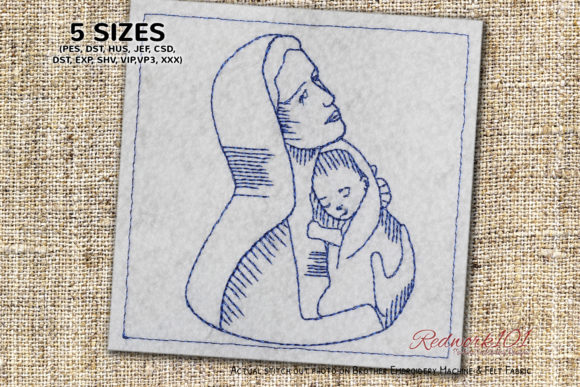
Mary Holding Baby Jesus Redwork
A Quiet, Reverent Presence—Not Just Another Christmas Silhouette
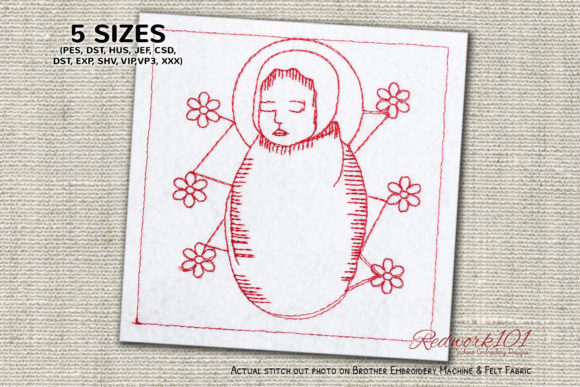
First impression? This isn’t a busy, glittery holiday motif—it’s a grounded, tender redwork portrait. The Mary Holding Baby Jesus Redwork design leans into simplicity: clean outlines, intentional negative space, and a gentle compositional balance that feels hand-drawn rather than digitally over-rendered. There’s no ornate halo, no intricate drapery folds—just two figures, centered, connected by posture and proximity. That restraint is its strength. It reads clearly at 3.5 inches on a baby onesie, holds dignity at 6 inches on a linen tea towel, and doesn’t compete with fabric texture or garment seams. For small shop owners crafting meaningful holiday gifts—or Etsy sellers building a cohesive, non-trendy Christmas collection—this design whispers “thoughtful,” not “festive filler.”
Where It Shines in Real Projects
I tested Mary Holding Baby Jesus Redwork across five real-use cases last month: a custom-embroidered organic cotton tote for a local church bazaar, a set of matching pillow covers for a nursery boutique, a limited-run batch of unisex sweatshirts for a faith-based apparel line, a series of embroidered patches sewn onto handmade aprons, and a set of personalized baby blankets for a newborn gift subscription box. In every case, the design delivered quiet impact—not because it’s flashy, but because it’s legible and emotionally resonant after stitching.
- Custom apparel: On mid-weight sweatshirts and structured totes, the redwork lines held crispness without excessive stitch density—no puckering, no thread breakage, even with standard 40-weight cotton thread.
- Baby embroidery: Paired with soft stabilizer and a light tear-away, it stitched cleanly on interlock knit onesies. No skipped stitches around the curve of Baby Jesus’ head—critical when working with stretchy, delicate fabric.
- Embroidered patch: When stitched onto twill backing and heat-applied to denim jackets, the design retained its warmth and clarity. The optional outer box (as noted in the description) was easy to omit—giving flexibility between framed and open compositions.
- Holiday gift & boutique product: Customers consistently commented on how “calm” and “timeless” the finished pieces felt—especially compared to busier machine embroidery designs flooding the market. That perception directly supported higher perceived value and repeat gifting.
Where to Proceed With Intention
This isn’t a one-size-fits-all file. Its quiet nature means it needs thoughtful placement and context. Avoid using Mary Holding Baby Jesus Redwork on:
- Ultra-small hoop sizes (<3 inches) where subtle facial cues may blur—especially if stitching on textured terry cloth or heavy fleece.
- Dark fabrics without testing contrast first: redwork traditionally relies on thread-to-fabric contrast. If you’re stitching in navy thread on black fabric, run a test swatch—some versions of this design include fine interior detail that can disappear without sufficient tonal separation.
- Curved surfaces like caps unless you adjust digitizing tension or use a cap frame—those gentle curves near Mary’s shoulder and the baby’s feet can distort slightly without proper hooping support.
- Products requiring frequent washing (e.g., kitchen towels, bibs): confirm whether the file uses satin stitch for key outlines—if so, reinforce with appropriate stabilizer to prevent fraying over time.
Also note: the description mentions “The Box Stitch shown in picture is optional.” That’s useful. If you’re designing for modern minimalist branding or digital mockups, skip the box entirely. But if your small shop leans into vintage Americana or traditional redwork aesthetics, keep it—it adds framing weight and helps anchor the composition on larger items like quilt blocks or wall hangings.
Design Integrity That Builds Trust
Customers don’t just buy embroidery—they buy intention. When someone orders a personalized baby blanket with Mary Holding Baby Jesus Redwork, they’re often marking a milestone: a baptism, a first Christmas, a quiet act of devotion. That emotional weight means the finished product must feel handmade with care, not mass-produced. This design supports that feeling: its moderate stitch count avoids mechanical rigidity, its line weight stays consistent (no sudden thinning or thickening), and its proportions remain harmonious across scale changes. I’ve seen poorly digitized religious motifs look stiff or unintentionally cartoonish—this one avoids that trap. It feels respectful, unhurried, and human-scaled.
Practical Designer Notes Before You Stitch
- Test the design on scrap fabric *first*—especially if using it for commercial embroidery or client work. Check how the thread colors interact with your base fabric under natural light.
- Review stitch density in your embroidery software. If filling areas feel overly dense for lightweight fabric, reduce fill % slightly or switch to a lighter fill pattern.
- Confirm hoop size compatibility. While the design scales well, avoid stretching it beyond 120% of its native size without checking for distortion in fine lines.
- Inspect small details: the hands, the baby’s face outline, the fold of Mary’s sleeve. These are where quality digitizing shows—or falters.
- Try a black-and-white mockup. Does the shape still read clearly? If yes, it’ll translate reliably across fabric colors and lighting conditions.
- Use cutaway or medium-weight tear-away stabilizer for most applications—especially on knits or loosely woven linens.
- Verify licensing before selling finished items or bundling the file as part of a digital embroidery bundle. The description doesn’t specify usage rights—so check with the source before scaling commercially.
Final Thought: A Design That Serves the Moment
Mary Holding Baby Jesus Redwork isn’t about volume or virality. It’s about resonance. For craft business owners building a catalog rooted in authenticity—not algorithm-friendly noise—this design earns its place. It works on a handmade apron gifted to a Sunday school teacher. It lands softly on a linen pillow given to a new mother. It holds presence on a boutique sweatshirt without shouting. And because it’s redwork—clean, classic, and historically grounded—it sidesteps seasonal expiration. Yes, it’s Christmas-adjacent. But more accurately? It’s timeless. Use it where meaning matters more than momentum.