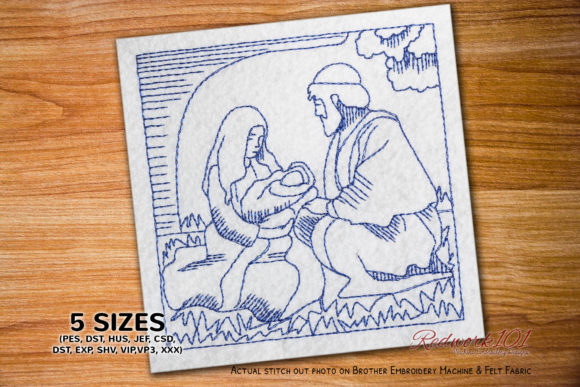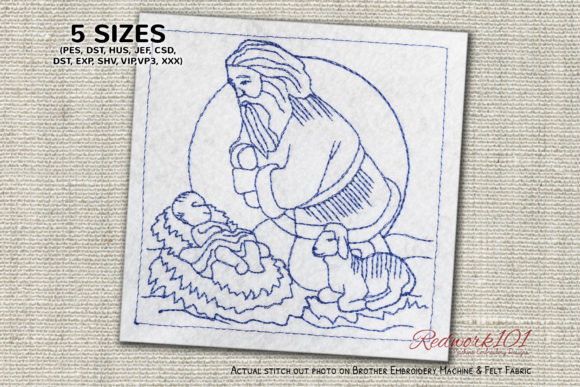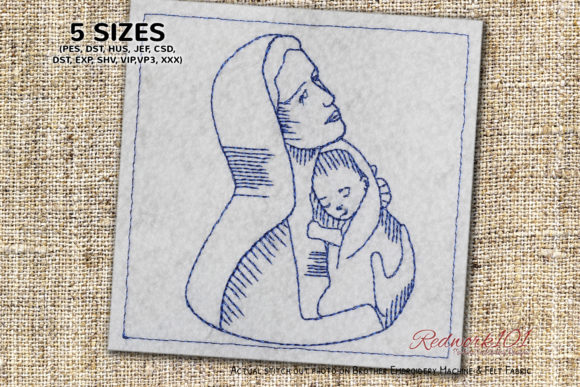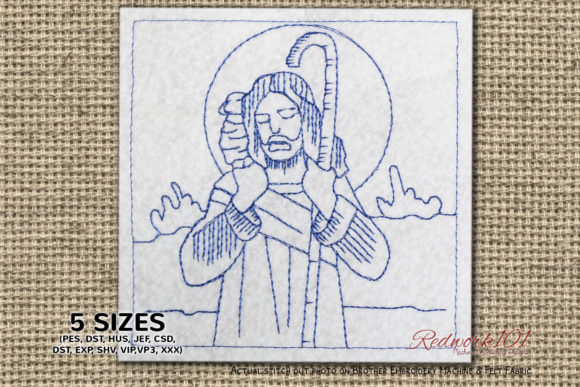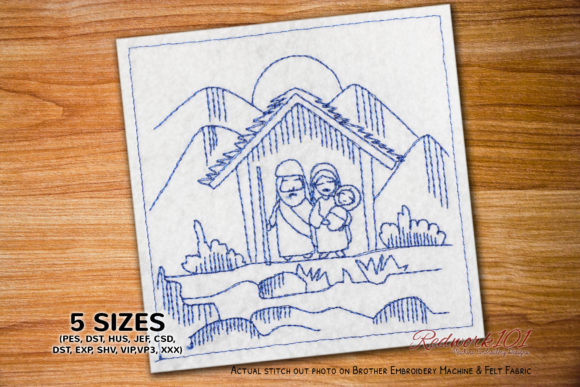
Mary with Jesus and Joseph Redwork
A Thoughtful Design Review for Small Business Merchandise
As an embroidery designer who’s developed hundreds of commercial designs for cafés, boutiques, bakeries, florists, pet brands, and Etsy sellers, I approach Mary with Jesus and Joseph Redwork not just as a holiday motif—but as a functional brand asset. Its redwork style immediately signals warmth, tradition, and handmade sincerity—qualities that resonate deeply with customers seeking authenticity. It reads as classic rather than dated, reverent without being stiff, and quietly elegant without demanding attention. That balance makes it unusually versatile across small business applications.
Where This Design Shines in Real-World Use
Mary with Jesus and Joseph Redwork excels where storytelling meets wearability. On embroidered patches—especially 2" to 3.5" versions—it anchors brand identity with quiet confidence. Think: a local florist stitching it onto canvas aprons for holiday pop-ups, or a family-run bakery attaching it to staff caps during Christmas markets. The clean line work and open negative space translate beautifully to cap embroidery, sleeve accents, and tote bag designs—no overcrowding, no visual fatigue.
For custom apparel, this design works especially well on mid-weight cottons, twills, and linen blends—fabrics commonly used in aprons, work shirts, and boutique merchandise. Its moderate stitch density avoids bulk while retaining definition after repeated washing. As a chest logo accent, it adds seasonal warmth without overshadowing your core brand mark. And because redwork traditionally relies on strong contrast (often red thread on natural fabric), it adapts seamlessly to light-to-medium fabric tones—ideal for unbleached canvas totes, oatmeal-colored uniforms, or cream aprons.
Small businesses also benefit from how Mary with Jesus and Joseph Redwork supports cohesive gifting and packaging. Stitched onto muslin gift tags, mini pouches, or product labels, it elevates handmade products without competing with product photography. For Etsy sellers, it strengthens visual consistency across listings—pair it with printable mockups showing the design on mugs, notebooks, and garment tags to build buyer trust through repetition and polish.
Use With Intention: Where Caution Applies
This design isn’t ideal for every surface or scale. At under 1.75", fine details—like facial features or delicate drapery lines—can blur or vanish entirely, especially on textured fabrics like fleece or heavy denim. Cap fronts under 2" may lose clarity unless simplified first; consider requesting a streamlined version from your digitizer if tight sizing is non-negotiable.
The optional Box Stitch framing (mentioned in the description) deserves special attention. While it adds structure and visual framing, that outer border increases hoop size requirements and stitch count. If you’re embroidering on curved surfaces—like structured caps or tapered tote handles—the box may distort unless digitized with stretch compensation. Also, avoid placing the full-box version directly over seams or high-stress areas where thread tension shifts during wear.
Dark uniforms require careful thread color review. Traditional redwork assumes light fabric—so if your team wears navy or charcoal, test alternate thread colors (deep burgundy, burnt sienna, or even charcoal-gray) to preserve legibility. Always check spacing between figures: too-tight grouping risks “thread nesting” on low-density stabilizers, especially on lightweight poly-blends.
How It Strengthens Brand Identity and Customer Connection
In a crowded marketplace, Mary with Jesus and Joseph Redwork does more than signal Christmas—it communicates values. Its hand-drawn charm reinforces handmade product credibility. Its gentle symmetry conveys care and intentionality. That matters to customers choosing a local café over a chain, or supporting an Etsy maker over mass production. When stitched consistently across staff aprons, customer totes, and gift packaging, it builds recognition—not just of the season, but of *your* brand’s consistent voice and values.
Importantly, it avoids trend fatigue. Unlike flashy metallic or glitter-filled holiday motifs, redwork ages gracefully. You can reuse this design year after year—not just for December, but for Advent workshops, nativity-themed pop-ups, or faith-based community events—extending its ROI far beyond a single season.
Practical Designer Notes Before Production
Before ordering or digitizing Mary with Jesus and Joseph Redwork for commercial embroidery:
- Test in black and white first—verify contrast and readability without relying on color assumptions.
- Check minimum viable patch size—run a 2" version on your embroidery software to assess detail retention.
- Review thread color contrast against your actual fabric swatches—not just on screen.
- Inspect spacing and underlay—tight figure groupings need proper underlay to prevent puckering on stretchy or lightweight fabrics.
- Confirm hoop size compatibility—especially if using the optional Box Stitch frame.
- Test on real fabric with correct stabilizer—cutaway for knits, tear-away for stable wovens, fusible for lightweight linens.
- Create a physical mockup before client approval—digital previews rarely capture texture, drape, or sheen.
- Compare beside your existing design assets—does it align tonally with your logo, typography, and other embroidery files?
- Verify commercial licensing—ensure your digital embroidery file permits use on merchandise sold to end customers.
Remember: Mary with Jesus and Joseph Redwork isn’t just a Christmas embroidery file—it’s a brand-building tool. Used thoughtfully, it deepens connection, reinforces craftsmanship, and turns everyday items—aprons, caps, totes—into quiet ambassadors for your small business. Whether you're a solo craftsperson or a growing boutique, let this design serve your mission, not just your calendar.